VAE


title: VAE
date: 2026-02-11 00:15:46
categories:
- 项目
- 生成模型之旅
tags:
- 生成模型

VAE (变分自编码器) 探索

理解

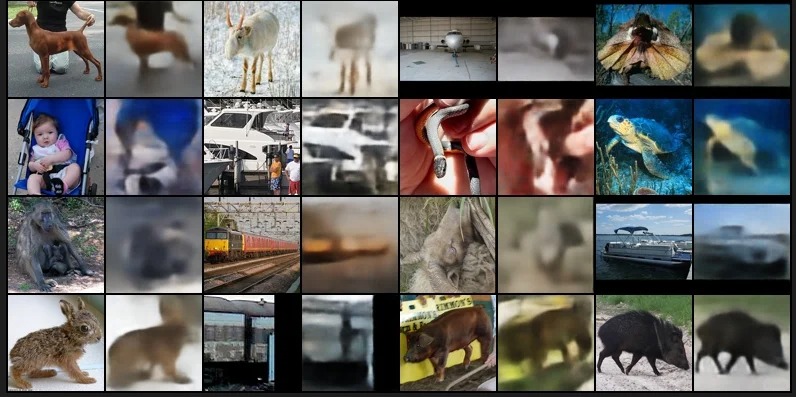
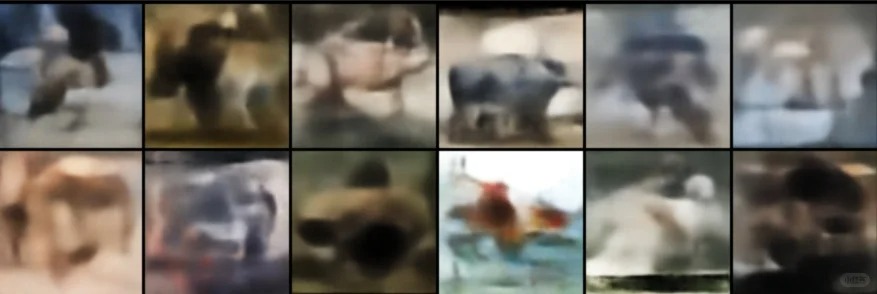
VAE 用 encoder 学近似后验 $q(z|x)$,用 decoder 学生成分布 $p(x|z)$。训练时最大化 ELBO:要能从 $z$ 重建 $x$,又用 KL 把 $q(z|x)$ 拉向标准正态先验,让潜空间更连续可采样。因此在潜空间里随机采样就能生成新图片,并且出现部分语义的聚类,但是相比于ddpm更加模糊,或者说是平滑。

(源代码没有留存,下文的code是纯ai写的,测试blog的code功能,仅供参考)

实现细节

数据集与参数

  • 使用CIFAR-10数据集,输入图片为32x32x3,输出图片也为32x32x3
  • 使用MSE损失函数
  • 消费级显卡即可训练

模型架构

1. 初始化方法 (__init__)

  • 设置模型的基本参数:潜在空间维度、通道数、图像尺寸、输入通道数
  • 定义编码器(Encoder):包含4层卷积层,逐步将输入图像缩小并提取特征
  • 定义潜在空间映射:将编码后的特征映射到潜在空间的均值和方差
  • 定义解码器(Decoder):包含4层转置卷积层,将潜在向量重建为图像

2. 编码器 (encode)

  • 将输入图像通过卷积网络进行特征提取
  • 将提取的特征展平并通过全连接层映射到潜在空间的均值(mu)和对数方差(logvar)

3. 重参数化技巧 (reparameterize)

  • 实现VAE的关键技巧,允许模型进行端到端训练
  • 通过添加噪声样本,从潜在分布中采样

4. 解码器 (decode)

  • 将潜在向量通过全连接层扩展,然后重塑为卷积特征图
  • 通过转置卷积层逐步重建图像

5. 前向传播 (forward)

  • 完整的VAE流程:编码 → 重参数化 → 解码
  • 返回重建图像、均值、对数方差和潜在向量

核心代码

1
2
3
4
5
6
7
8
9
10
11
12
13
14
15
16
17
18
19
20
21
22
23
24
25
26
27
28
29
30
31
32
33
34
35
36
37
38
39
40
41
42
43
44
45
46
47
48
49
50
51
52
53
54
55
56
57
58
59
60
61
62
import torch
import torch.nn as nn

class ConvVAE(nn.Module):
def __init__(self, latent_dim=128, channels=64, img_size=32, in_ch=3):
super().__init__()
if img_size % 16 != 0:
raise ValueError("img_size must be divisible by 16 (because 4 downsamples).")

self.latent_dim = latent_dim

# 编码器
self.encoder = nn.Sequential(
nn.Conv2d(in_ch, channels, 4, 2, 1), nn.ReLU(),
nn.Conv2d(channels, channels*2, 4, 2, 1), nn.BatchNorm2d(channels*2), nn.ReLU(),
nn.Conv2d(channels*2, channels*4, 4, 2, 1), nn.BatchNorm2d(channels*4), nn.ReLU(),
nn.Conv2d(channels*4, channels*8, 4, 2, 1), nn.BatchNorm2d(channels*8), nn.ReLU(),
)

was_training = self.encoder.training
self.encoder.eval()
with torch.inference_mode():
x = torch.zeros(1, in_ch, img_size, img_size)
h = self.encoder(x)
self._enc_shape = h.shape[1:] # (C, H, W)
self._flat_dim = h.flatten(1).size(1) # C*H*W
self.encoder.train(was_training)

# Latent mappings
self.fc_mu = nn.Linear(self._flat_dim, latent_dim)
self.fc_logvar = nn.Linear(self._flat_dim, latent_dim)
self.fc_decode = nn.Linear(latent_dim, self._flat_dim)

# 解码器
self.decoder = nn.Sequential(
nn.ConvTranspose2d(channels*8, channels*4, 4, 2, 1), nn.BatchNorm2d(channels*4), nn.ReLU(),
nn.ConvTranspose2d(channels*4, channels*2, 4, 2, 1), nn.BatchNorm2d(channels*2), nn.ReLU(),
nn.ConvTranspose2d(channels*2, channels, 4, 2, 1), nn.BatchNorm2d(channels), nn.ReLU(),
nn.ConvTranspose2d(channels, in_ch, 4, 2, 1),
nn.Sigmoid(),
)

def encode(self, x):
h = self.encoder(x).flatten(1)
mu = self.fc_mu(h)
logvar = self.fc_logvar(h)
return mu, logvar

def reparameterize(self, mu, logvar):
std = torch.exp(0.5 * logvar)
eps = torch.randn_like(std)
return mu + eps * std

def decode(self, z):
h = self.fc_decode(z).view(z.size(0), *self._enc_shape)
return self.decoder(h)

def forward(self, x):
mu, logvar = self.encode(x)
z = self.reparameterize(mu, logvar)
recon = self.decode(z)
return recon, mu, logvar, z

损失函数

损失函数由两部分组成:

  • recon(重建误差)
  • KL(把 q(z|x) 拉向标准高斯 N(0,I)
1
2
3
4
5
6
7
8
9
10
11
12
13
14
15
16
17
18
19
20
21
22
23
24
25
26
from __future__ import annotations

import torch
import torch.nn.functional as F


def vae_loss(
recon: torch.Tensor,
x: torch.Tensor,
mu: torch.Tensor,
logvar: torch.Tensor,
*,
beta: float = 1.0,
reduction: str = "mean",
) -> dict[str, torch.Tensor]:
red = "sum" if reduction == "sum" else "mean"

recon_loss = F.mse_loss(recon, x, reduction=red)

# KL(q(z|x) || N(0, I)) per-sample: [B]
kld_per = -0.5 * (1 + logvar - mu.square() - logvar.exp()).sum(dim=1)
kld = kld_per.sum() if red == "sum" else kld_per.mean()

loss = recon_loss + beta * kld
return {"loss": loss, "recon": recon_loss, "kld": kld}

实验结果

重建效果

随机采样生成效果


VAE
http://www.wsgbxx.com/2026/02/11/VAE/
Author
wsgbxx
Posted on
February 11, 2026
Licensed under